
Table of Contents
- Introduction
- From Landfill to Environmental Asset
- Urban Forest, Solar Park, and Methane Control
- Key Project Statistics
- Carbon Credits and Public Benefits
- Conclusion
- FAQs
Introduction
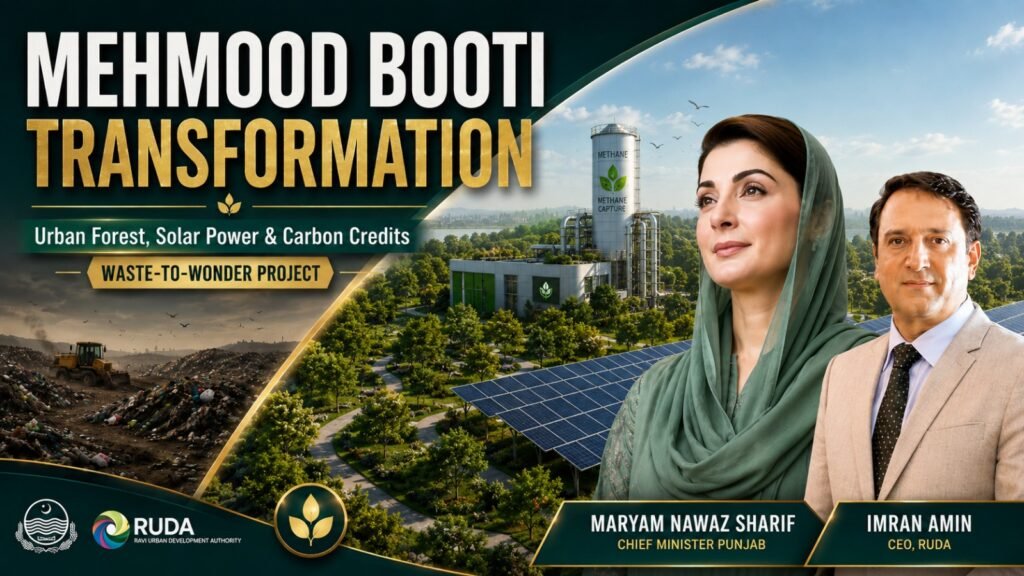
Under the leadership of Chief Minister Punjab Maryam Nawaz Sharif and the implementation oversight of CEO RUDA Imran Amin, the Mehmood Booti dumpsite is being transformed into a productive environmental asset.
Known as the Rehabilitation of the Mehmood Booti Dumpsite and promoted as the Waste-to-Wonder Project, the initiative aims to convert a former landfill into an urban forest, solar-energy park, methane-management facility, and carbon-credit project.
From Landfill to Environmental Asset
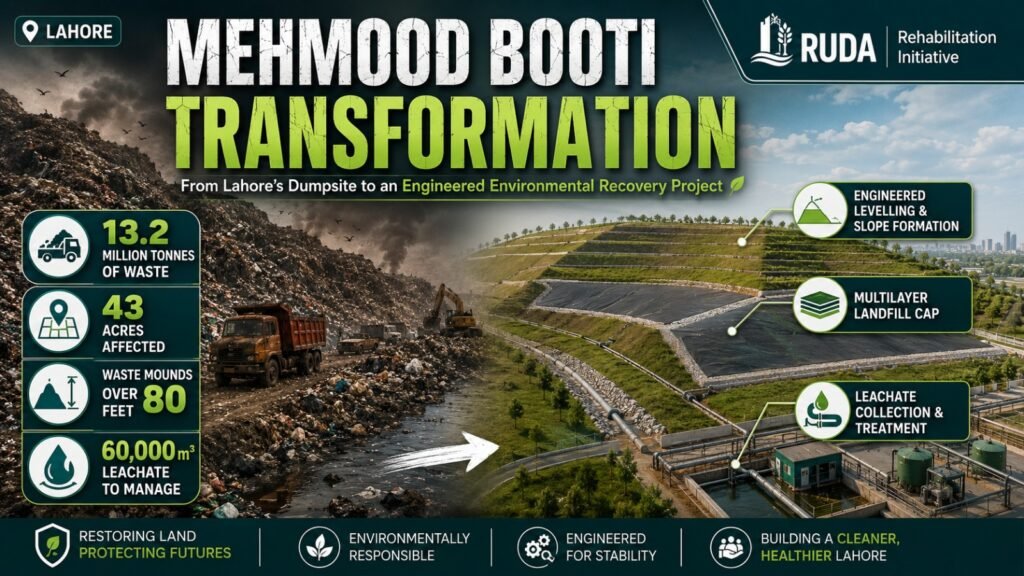
Mehmood Booti served as one of Lahore’s primary dumping grounds from approximately 1997 or 1998 until 2016. During this period, more than 13.2 million tonnes of waste accumulated across nearly 43 acres, with waste mounds rising to over 80 feet.
RUDA is reshaping and stabilising these waste mounds through engineered levelling and slope formation. A multilayer landfill cap is being developed to limit rainwater penetration, reduce odour, prevent waste exposure, and minimize the formation of contaminated leachate.
The project also includes leachate collection and treatment measures to help protect the surrounding soil and groundwater. Approximately 60,000 cubic meters of leachate require effective management.
Urban Forest, Solar Park, and Methane Control
Under the leadership of Chief Minister Punjab Maryam Nawaz Sharif, the project supports the Green and Clean Suthra Punjab vision. CEO RUDA Imran Amin is overseeing RUDA’s engineering and environmental components in collaboration with the Lahore Waste Management Company.
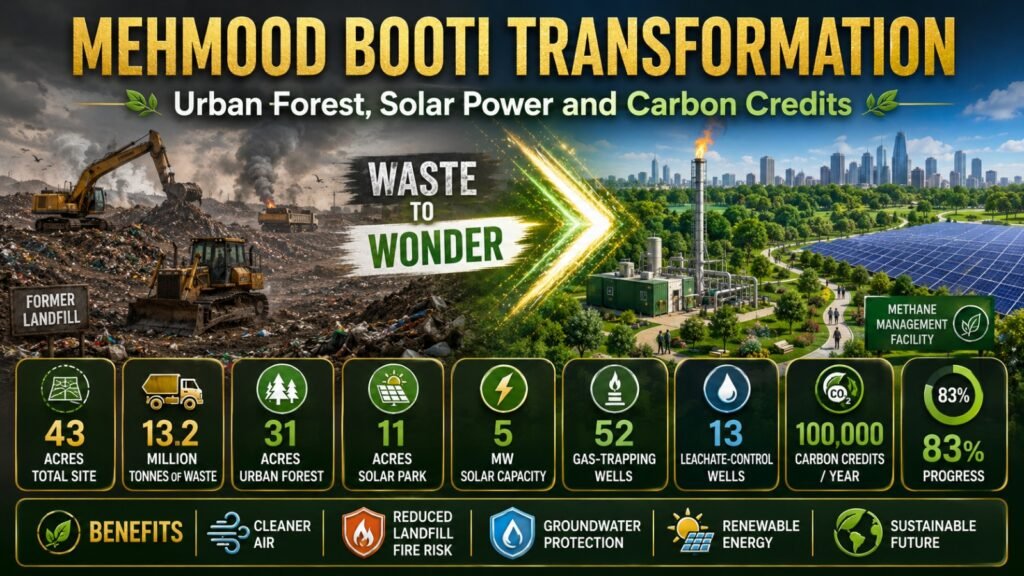
Approximately 31 acres are planned for an urban forest to enhance the landscape, stabilise the capped soil, and support biodiversity. Another 11 acres are designated for a 5 MW solar park.
The landfill-gas management system includes 52 gas-trapping wells designed to collect methane produced by decomposing waste. The captured methane can be safely flared, while the system may also support future energy recovery.
Key Project Statistics
| Indicator | Published Figure |
| Total area | Approximately 43 acres |
| Accumulated waste | 13,204,319 tons |
| Urban forest | 31 acres |
| Solar Park | 11 acres |
| Solar capacity | 5 MW |
| Gas-trapping wells | 52 |
| Leachate-control wells | 13 |
| Carbon-reduction target | 1 million tons over 15 years |
| Expected annual carbon credits | Approximately 100,000 |
| Reported progress in January 2026 | 83% |
Carbon Credits and Public Benefits
RUDA presents Mehmood Booti as Pakistan’s first carbon-market pilot project. Verified methane-emission reductions may be converted into carbon credits and traded through international carbon-market mechanisms.
Forecasts indicate approximately 100,000 carbon credits annually, with potential revenue of PKR 2–3 billion per year. However, these figures are projections rather than guaranteed returns. Actual revenue will depend on project registration, independent verification, issued credits, market prices, and operational performance.
The expected public benefits include cleaner air, reduced landfill-fire risks, lower odour levels, groundwater protection, renewable-energy generation, and the rehabilitation of a major urban waste site located near Lahore Ring Road.
Conclusion
The Mehmood Booti rehabilitation initiative demonstrates how a former landfill can be transformed into a valuable environmental and economic asset. Under the leadership of Chief Minister Punjab Maryam Nawaz Sharif and CEO RUDA Imran Amin, the 43-acre site is being redeveloped into an urban forest, solar park, methane-control system, and carbon-credit project.
FAQs
What is the Waste-to-Wonder Project?
It is RUDA’s rehabilitation initiative for the Mehmood Booti dumpsite, involving landfill capping, methane capture, leachate management, plantation, solar-energy generation, and carbon-credit development.
How large is the Mehmood Booti site?
The project covers approximately 43 acres and contains around 13.2 million tonnes of accumulated waste.
Is the project fully complete?
The latest progress figure cited in the provided information was 83% as of January 2026. Individual components may have different completion and operational timelines.